Building a Card Game Engine: A Journey from Idea to Reality
How I created a flexible foundation for building any card game
Have you ever wanted to create your own card game but felt overwhelmed by all the things you'd need to build? The shuffling, dealing, scoring, and user interface can quickly become a tangled mess of code. That's exactly the problem I set out to solve with the Card Game Engine — a foundation that handles all the boring stuff so you can focus on what makes your game unique.
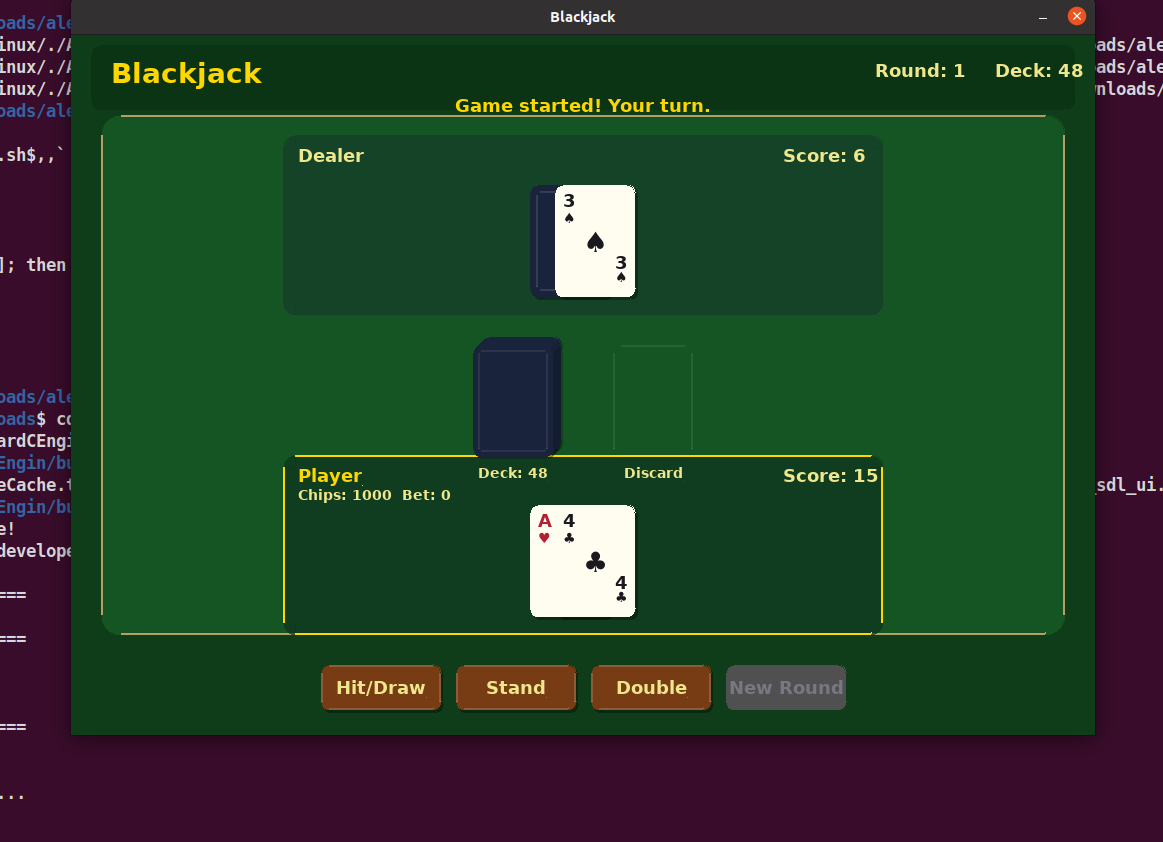
The engine running a Blackjack game — players see their cards, scores, and available actions
The Big Idea
The core philosophy behind this project is simple: separation of concerns.
Think of it like building with LEGO blocks. The engine provides all the standard pieces — cards, decks, players, hands — and you just need to describe the rules of your game. Want to build Blackjack? Just tell the engine how to calculate scores and when someone wins. Want to build Poker? Same engine, different rules.
What the Engine Handles
- Card management — Creating decks, shuffling, dealing cards
- Player tracking — Managing multiple players, their hands, chips, and scores
- Game flow — Rounds, turns, and game state
- User interface — A complete graphical display with cards, buttons, and information panels
- Input handling — Button clicks and player actions
What You Define
- How to calculate a hand's value
- What actions are available (hit, stand, fold, etc.)
- Win/lose/draw conditions
- Any special rules unique to your game
The Technology Choices
Every project involves making choices, and here are the key decisions I made:
Why C?
I chose C for a few reasons:
- Performance — Card games might seem simple, but when you add animations and real-time graphics, speed matters
- Portability — C code can run almost anywhere
- Learning opportunity — Building something from scratch in C teaches you a lot about how things really work
Why SDL2 for Graphics?
I initially experimented with GTK (a popular toolkit for Linux applications), but ultimately chose SDL2 (Simple DirectMedia Layer) because:
- Cross-platform — Works on Windows, Mac, and Linux without changes
- Game-focused — SDL2 is designed for games and multimedia, making it perfect for card animations and smooth graphics
- Simpler — Less setup required compared to full GUI toolkits
- Community — Huge community with lots of examples and resources
Why a Callback-Based Architecture?
Instead of forcing game developers to modify engine code, I designed a "callback" system. You simply provide functions that answer questions:
- "What's the score of this hand?" → Your scoring function
- "What actions can this player take?" → Your available actions function
- "Who won?" → Your win condition function
The engine calls your functions at the right moments. You never touch the engine code itself.
Key Decisions Along the Way
Decision 1: Generic Game Runner
Early versions required each game to manage its own game loop and UI updates. This meant duplicating a lot of code between Blackjack and High-Low.
The solution? A Game Runner — a component that manages the entire game lifecycle. Now, launching any game is a one-liner. The runner handles the loop, the UI, and just asks your game rules what to do next.
Decision 2: Dynamic Action Buttons
Different games have different actions. Blackjack has "Hit" and "Stand." Poker might have "Call," "Raise," and "Fold."
Rather than hard-coding buttons, the UI asks the game: "What can the player do right now?" The game responds with a list, and the UI automatically creates the right buttons. This means adding a new action to your game is just adding it to a list — no UI code changes needed.
Decision 3: Dealer as a Special Player
In many card games, there's a "dealer" or "house" that plays differently from regular players. Instead of creating a separate system, I simply added an is_dealer flag to players. The UI knows to display dealers differently (cards partially hidden, positioned at the top), but the underlying mechanics remain the same.
What It Looks Like
The screenshot above shows the engine running Blackjack. Notice a few things:
- Clean layout — The dealer sits at the top, the player at the bottom
- Information at a glance — Round number, deck count, and scores are always visible
- Face-down cards — The dealer's hidden card appears as a card back
- Action buttons — "Hit/Draw," "Stand," "Double," and "New Round" appear based on the current game state
- Chip tracking — Player's chips and current bet displayed clearly
All of this is handled automatically. The Blackjack game code just focuses on the rules of Blackjack.
Lessons Learned
Start with the interface, not the implementation — Designing how game developers would use the engine before building it led to a much cleaner design
Flexibility requires planning — Making something generic is harder than making something specific, but it pays off when you want to add new games
UI and logic must be separate — The moment you mix display code with game rules, everything becomes harder to change
Test with real games — Building Blackjack and High-Low alongside the engine caught design problems early
What's Next?
The engine is now open source and ready for others to use. Future possibilities include:
- Network multiplayer support
- More card game examples (Poker, Uno, War)
- Sound effects and music
- Mobile versions using SDL2's mobile support
Try It Yourself
The Card Game Engine is available on GitHub. Whether you want to build the next great card game or just learn how game engines work, I hope this project provides a solid foundation.
Building something that makes other people's projects easier is deeply satisfying. Every card game built on this engine is a win for the philosophy that good tools make better games.
Happy coding, and may your draws always be lucky! 🃏